AGH Co-Founder and President Dr. Yuan has been appointed Associate Professor in the Department of Energy and Mineral Engineering at The Pennsylvania State University. In recognition of his foundational contributions to subsurface resource engineering and geological hydrogen (GeoH₂) systems, Dr. Yuan has also been awarded the prestigious Quentin E. and Louise L. Wood University Endowed Faculty Fellowship. He is also an affiliated researcher with Penn State's Institute of Energy and the Environment.
Engineered Rock Transformation for Stimulated Geologic Hydrogen
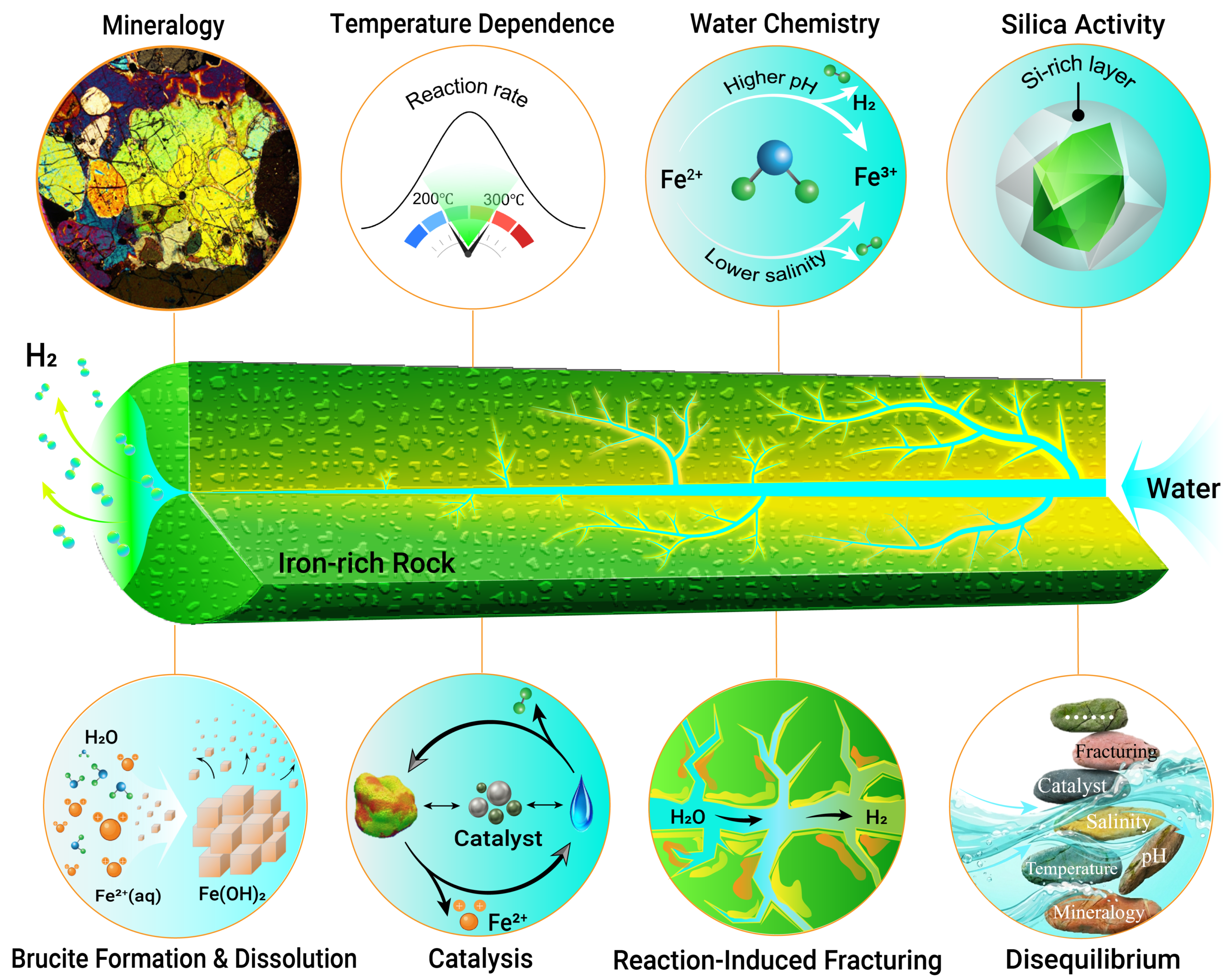
In a comprehensive review published in Energy & Environmental Science (2026), Dr. Yuan and co-authors established an engineering roadmap for accelerating in-situ underground serpentinization from geological epochs down to human operational timescales.
Fig. 1: Mechanistic controls of GeoH₂ generation: mineralogy, thermal regimes, water chemistry, secondary minerals, catalysis, fracturing, and fluid circulation pathways governing subsurface serpentinization (Yuan et al., 2026).
Mechanistic Controls: The study demonstrates how tuning reservoir temperature, mineral catalysis, and dynamic fluid chemistry can unlock massive hydrogen production in accessible continental iron-rich rock formations.
Global Scale: Engineering these rock-water interactions could potentially yield 7.40 × 10⁵ to 1.73 × 10⁶ million metric tons of hydrogen worldwide.
A sister review paper on naturally occurring hydrogen, previously co-authored by Dr. Yuan in the same journal, can be found in Mao et al. (2025).
Decoupling Open vs. Closed Reservoir Boundary Dynamics
Dr. Yuan’s publication in the International Journal of Hydrogen Energy introduces a predictive thermodynamic and kinetic model comparing open and closed geochemical boundary conditions during subsurface stimulation (Nwanwe et al., 2026).
Key Finding: Open systems—where active fluid circulation continuously replenishes reactants and removes products — yield 10 to 20 times more GeoH₂ than closed reservoir systems.
Engineering Impact: These quantitative baselines provide essential criteria for designing high-efficiency field stimulation treatments, well completion strategies, and long-term production extraction protocols.